07 April 2008

Can they spin it?

This essay was first published in the Drill Press digital magazine Spooky Action at a Distance. For the original click here. For the version in portuguese click here.


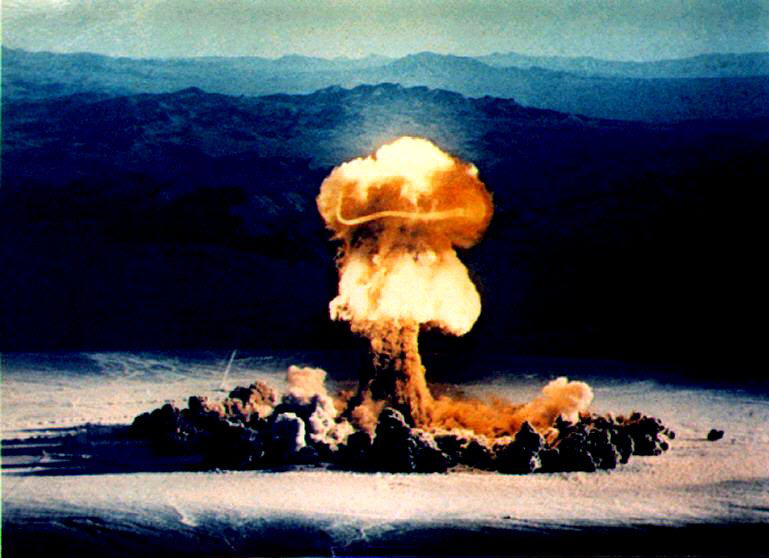
The Bush administration has been eager to stop Iran’s drive towards becoming a nuclear power. It spent years pushing for Security Council sanctions, pressuring for international inspections, etcetera; everything short of declaring war (but coming pretty damn close to it). And then along came the last U.S. National Intelligence Estimate (NIE) on Iran’s nuclear weapons program informing that the program has been halted since 2003. Many have been quick to point out the seemingly obvious, how that ruins the American case against Iran. However, cooked up with another purpose in mind, the November 2007 (released in December) NIE is NOT a definitive blow to Bush’s Iran policy; it can work either for it or against it. It all depends on how the administration sells the report.

First of all, let’s take a second to look back at NIE records and ponder just how reliable they are, and thus how seriously this one should be taken. Misinformed NIEs were at the heart of most major misperceptions and subsequent foreign policy screw-ups during the Cold War and beyond. Faulty intelligence assessments led to Eisenhower’s “bomber gap” of the late 50’s and JFK’s “missile gap” of the late 50’s/early 60’s which helped re-fuel the tensions among both superpowers. NIEs backed Khrushchev’s boasts of “burying the US” in the economic and military race and led many to believe the USSR might surpass the US, while the Soviet economy was really holding by strings. Later NIEs came out to dispel these misperceptions, but only when reality was already clear enough. More recently, NIEs came out supporting and then denying claims of Iraqi WMDs, Al Qaeda’s ties with Saddam and, of course, Iran’s nuclear weapon program. So, the best we can say about intelligence estimates is that they are right 50% of the time. The worst we can say is that they’re just as biased as any other government document and serve a policy purpose; they’re as much a cause of policy as a consequence of it.

The NIE in question is no different. It shouldn’t be regarded as an input that can change policy directives, but as a result of changes which already occurred and made it necessary - and possible - for the government to ease the pressure on Iran. Some of the main ones are the deepening of the financial crisis in the US and now creeping recession, the relative improvement in Iraq (which can be traced to less Iranian interference, some argue), sky-rocketing oil prices, worsening Russian-American relations, and the political crisis in Pakistan. If an intervention (multilateral or otherwise) in Pakistan is to be considered even as ultima ratio the US must be at relative ease with Iran. The presidential election should probably be factored in as well, but not to the same extent as the above, since it doesn’t pose such unambiguous incentive regarding the Iranian situation. All these elements make it extremely hard for the US government to push against Iran. For that alone the NIE, by minimizing the sense of urgency and impending doom that had been previously overplayed by American diplomats and pundits, can be accounted favoring American policy.

On the other hand, to the extent that the report can be interpreted as evidence that the US has been wasting time and energy, it’s largely a push on a shove. Talks with Iran have been clearly going nowhere for some time now. Ahmadinejad has only profited from the attention, boosted his confidence and sounds as provocative as ever. Meanwhile, Iranian uranium processing capabilities are developing and sanctions are yet to have a serious effect on the country’s economy. Iran is far from isolated: its relations with central- and east-Asian countries are holding up fine. China, for example, already relies on Iran for over 10% of its crude oil imports and has recently signed a multi-billionaire agreement to partner up with Iran to explore the Yadavaran oilfield. That the US has been wasting a lot of time and energy on Iran is a given, and we don’t need the NIE to tell us that.

Herein lies the twist: While the NIE states that, contrary to all previous expectations, from 2003 to at least mid-2007 the Iranian nuke program was halted, it also states - and that’s the part we ought to stress – that “Iran has the scientific, technical and industrial capacity eventually to produce nuclear weapons if it decides to do so," BUT “may be more vulnerable to influence on the issue than we judged previously.” It goes on to say that “some combination of threats of intensified international scrutiny and pressures, along with opportunities for Iran to achieve its security, prestige, and goals for regional influence in other ways, might—if perceived by Iran’s leaders as credible—prompt Tehran to extend the current halt to its nuclear weapons program.” So, far from detracting from American efforts against Iran, the report actually upholds them as the cause undelying the suspension of the Iranian nuclear program in the first place! And it calls for more of the same.

Countries who gave up their nuclear weapon programs are not unheard of: South Africa, Libya and Brazil are just a few examples. And there is some truth to the claim that international pressure has had a hand in delaying the Iranian nuke program. The main problem with that line of reasoning, though, is that it seems to blissfully ignore the side-effects of mismanaged international pressure. For the greater part it has been worst than useless, actually adding to Ahmadinejad’s appeal, justifying his drive for an insurance against foreign (read American) intervention, and bringing Iran together with other “victims of imperialist harassment,” like Hugo Chavez's Venezuela.

The NIE comes, then, not to damage Bush’s Iran policy, but to save face and flip history on its head. No longer an oil-powered hatemonger bent on spreading nukes to terrorists and wiping Israel and their American patrons off the map, Tehran is supposed to be now a rational actor, “guided by a cost-benefit approach”. So all the US has to do is keep up the good work. Great news, huh?

27 August 2007

The Bad Decision Dinosaur (by Dorothy)


By Dorothy (found on catandgirl.com)
(If you can´t read it properly, click on it to open a bigger version)


This is, undoubtedly, one of the best comics/charges I ever put my eyes on.

The Bad Decision Dinosaur may look quite new to the reader, but I´m sure he has been near a few times, even if not properly noticed.

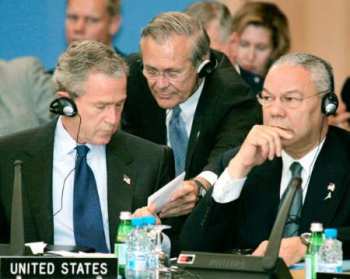
Here, for instance. Is quite hard to see him sometimes, but if you take a little time and effort staring...

Saw him here? I could spot him behind.


This is quite an old picture.
For as far as I know, Mr. Colin Powell resigned, and so did Mr. Donald Rumsfeld.

Nowadays, I imagine I´d see only Mr. Bush and the Bad Decision Dinosaur. But then again, I wish Mr. Bush gave a little time for the Dinosaur to visit some other "world leader in need".

Like Kim Jong-Il, e.g.

Awww...wishful thinking sucks!


With my best compliments.

P.S: This little piece of "IR amenities humour" is somehow a "firestarter" for a more technical and serious (yes, you heard me) accessment on Iraq, that shall be coming any time now.

20 August 2007

Bringing a shield to a missile fight?

A lot has been said about Bush's proposed missile shield to be deployed in Europe, the early-warning radar system to be placed in Eastern Europe, and Putin's reaction to it. But quite a lot has been left unsaid.

Official American statements call the missile defense system a precaution against “rogue states”. The Kremlin officially regards it as a threat to Russia's security and to the delicate balance of terror established during the Cold War. Despite the Bush administration's best efforts to reassure him, Putin has announced he is aiming missiles at Europe -- supposedly deactivated or redeployed since the end of the Cold War -- , buliding up his own air-defense system – so far unexplained – and withdrawing from the CFE (Treaty on Conventional Armed Forces in Europe). So, how much of that is justified, how much is overreaction and how much is Putin's way of cashing in on Bush's missteps? Our answer will be more inclined to the latter. Here's why.


First of all, the "delicate" balance of terror is not that delicate. In fact, the balance of terror is quite sturdy, and has proven to be so in the past half century. It has stood firm, despite repeated blows delivered throughout the years, ranging from the Berlin (1948-49, 1958-61, 1963) and Cuban (1962) crises; the emergence of new nuclear states (Britain 1952, France 1960, China 1964, India 1974 and Pakistan 1998); revolutions in warhead delivery and concealment capabilites (e.g.: the introduction of Submarine Launched Ballistic Missiles - SLBMs - and Multiple Independently targetable Reentry Vehicles - MIRVs); the break-up of the USSR (and the dangers that ensued, in terms of misplaced weapons and "abandoned" silos and nuclear facilities); and, last but not least, the first attempts towards the deployment of ABM systems. To those we can add the several other situations in wich nuclear powers came to the brink of conflict or even engaged in limited direct (Chinese and US fighter jets in Vietnam) or indirect (US/UN troops and Soviet-backed North-Koreans in Korea) confrontation. Throughout all these tense moments in our recent past, the balance of terror has not only stood unshaken, but one can say with great certainty that the shadow of thermonuclear war contributed massively to the non-escalation of the above mentioned crises.


Second, ABMs (Anti-Ballistic Missiles) pose no real threat to the array of forces in place in Europe, or to Russian security writ large. That is so mainly for the following reason: ABMs don't work. At least not the way most people think, or the way the Bush administration would like us to think. ABMs are not meant to protect large, obvious targets like countries or even cities. They are meant to protect "hard" targets (as opposed to cities, which are "soft" targets), like underground silos and launchpads. When used to secure large areas, ABMs can be easily countered by a simple addition of deceptive measures or an increase in numbers of vehicles (individual missiles or warheads in MIRVs), both easily attainable for Russia and China (and even Pakistan!), thus proving itself a big waste of time and money. When used to safeguard silos, ABMs guarantee the safety of the deterrent forces reinforcing second-strike capability, and are thus a stabilizing factor, not the other way around.


It was mainly for these two reasons that President Putin was not the least worried and was in fact quite understanding when President Bush first approached him regarding the setup of a missile shield in 2001 and later withdrew from the ABM Treaty (a treaty signed in 1972 limiting the deployment of ABMs).


What changed? Why is Putin now bent on putting and end to American missile shield intentions? The answer is short: He's not. What Putin really wants is to safeguard the Russian sphere of influence. That means keeping the US as far away as possible from Eastern Europe, especially the Ukraine and Bielorussia (pipeline countries), halting NATO enlargement and pressing the US on the Caucasus (Georgia, Chechnya and the likes). The American proposal to install bases in Poland and the Czech Republic just gave him a perfect excuse to press the US and still leave some ambiguity as to the burden of the initiation of hostilities.


As a bonus, Putin can hope to succeed in gathering support at home (with his """""constituency""""") and among his peers at the Shanghai Cooperation Organization. Russian intentions in the latter should not be misread either. The Russians are just as scared of the Chinese military program and the Iranian bomb as are the hawks in the Pentagon, or even more so. They just found a better way to cope with it. "Keep your friends close", goes the saying.


Cartoon by Kevin Kallaugher

10 March 2007

Nuclear Diplomacy of yore, today.

There is much controversy about the strategic impact of China's rise. Some optimists are led to believe that, despite its continuing efforts in modernizing the People's Liberation Army, China will be dissuaded to engage in direct confrontation and/or arms races with its peers due to the deep – and deepening – economic interdependence between Beijing and, well, the rest of the world, made clear by this week's stock sell-off.

While it is safe to say that an all-out war between China and the US or China and Japan is out of the question, an arms race in East Asia is not only coherent with China's economic situation, it is also consistent with the latest trends in Chinese military and defense R&D spending, augmented by approximately 400% in real terms over the last decade and scheduled to increase by another 18% or so in 2007.

21st Century China resembles, in more ways than one, the Soviet Union under Khrushchev, in that it sees its relationship with the outside world changing as a consequence of changes both in its internal structure – a process of institutionalization and policy reform resulting from the death of its iron-fist-leader – and a considerable shift in their position in the International System due to a burst of economic growth. Both surges of growth are/were questionable in respect to their sustainability, albeit for slightly different reasons.

Another important parallel to be traced here is the incapacity of American strategic thinkers and foreign policy formulators to see the true quality of their peer's ascendence and, consequently, to correctly assess the changes – or absence thereof – in the distribution of capabilities.

The eagerness to overstate the USSR's capabilities and buy into Khrushchev's megalomaniac rethoric in the late 50's led the “best and the brightest” in the USA to believe in the formation of a “missile gap”, that is, a disparity in the warhead-delivery capabilities of the Soviet Union and the United States, with the balance tipping in favor of the former. Overreaction may have been limited by the shadow of massive retaliation, Mutual Assured Destruction, to use a term coined soon after, but nonetheless the world came close to nuclear apocalypse on more than one occasion as politicians played James Dean riding on ICBMs. Nuclear weapons became the primary object and instrument of foreign policy for both poles. Berlin (1958-1961) and Cuba (1962) were landmarks which persisted all through the Cold War and beyond it. Brinkmanship and diplomacy became synonyms.

As China converts the dividends of its economic opening (not to be confused with liberalization) into political and military power, the first signs of American exageration appear in the form of speculation about concealed spendings and the true magnitude of China's military build-up. Beijing's recent display of might, shooting down an orbiting weather satellite with an IRBM, hardly a surprise for those of us who are on the more skeptic end of the theoretical spectrum, raised a lot of doubt and worry. A more than expected reaction to the latest twists and turns of American outer space policy – the unilateral imposition of limitations regarding the use of space –, as well as to the Japanese deployment of anti-missile measures and signs of possible rearmament¹, this formidable exercise of power may seem bellicose at first. At closer inspection, though, it's clearly a message from Beijing. A sign of a new age of foreign policy. For the US, it could mean a return to nuclear diplomacy of the 1960's. It's Sputnik all over again.


[1] For a more exhaustive assessment of Asian strategic scenario see "Gol de Placa", below.

24 January 2007

Insert witty title here

It's practically common sense – outside neo-conservative circles anyway – that jihadist terrorism cannot and should not be regarded as a traditional security threat. There is, on the other hand, little agreement over what is the correct way to portray, and deal with, this phenomenon. While I suggest a few insights to the former, I do not claim to have answer to the latter. In fact, my point is quite the opposite. Underlying my main argument here is the belief that there is no single cocktail of sound policies applicable to all countries troubled by terrorism. What I do claim, however, is that most measures currently being proposed and employed by European authorities are dead wrong, for they ignore a crucial aspect of the nature of the threat they face: the proliferation and "target selection" of jihadists is like the spreading of a venereal disease, that is to say, social in nature.

EU-US relations today are a source of building tension and complication. Fruitful and longstanding economic, military and political partnerships notwithstanding, the old continent watches carefully – though not carefully enough – as the unchained Gulliver rampages on, in its battle against terror. Unable to constrain it, most european countries have chosen to either remain neutral or bandwagon and assist, each its own way, the rampant giant. Said assistance is looser than tradicional millitary alliances in time of war. It is also intermittent, going back and forth, back and forth, repeatedly, just like... well, you've got the picture. This trend is not all that recent and can be traced back all the way to the early years of the Cold War. In many ways, this recent drift closely resembles the one in the late 50's/early 60's. This oscilatory solidarity, as it has been wittingly called by some, can be seen clearly in the EU's September 14th joint communiquè in respect to the victims of the 9/11 attacks, followed by the invoking of Article 5 of the NATO Charter and limited participation in the war in Afghanistan, as well as, later on, in the refusal of most european countries, with important exceptions, to engage in military action in Iraq.

Two of the above referred exceptions, Great Britain and Spain, have been targeted by terrorist cells linked to Al Qaeda and/or inspired by Al Qaeda's particular brand of jihadism. Though the connection seems obvious enough, european counter-terrorist efforts consist not of disengaging from the US, and run in the precise opposite direction, that is, of intensifying transatlantic relations. As Gijs de Vries, European co-ordinator for counter-terrorism, stated: “Terrorism is a common and urgent threat for both Europe and America. We are in it together.[...] It will be a long and painful struggle for all of us. All the more reason to work closely together.” So much for prophylactics... As long as this line of reasoning is followed, Europol and Justice and Home Affairs measures – many of which are also quite destructive, yet more effective – will be canceled out by the continued transatlantic intercourse.

As said before, no single batch of measures will do when it comes to fending off terrorism, but by acknowledging it's true nature, one general directive can be derived; one that european leaders would do well to abide by:


06 November 2006

Worst Case Scenarios: EUA x USSR

"Easy-as-ten-words-worst-case-scenarios"

Worst Case Scenario 1950: No more world. Simple as that.
Worst Case Scenario 1955: Earth becomes stardust. No more questions.
Worst Case Scenario 1960: Total devastation. No details to be discussed.
Worst Case Scenario 1965: All-in War. Global nuclear fallout. Then, mankind is gone.
Worst Case Scenario 1970: The planet is out of bounds. Life is impossible there.
Worst Case Scenario 1975: All pieces of the earth flying around the universe. Separately.
Worst Case Scenario 1980: Hesitation. Then thermonuclear war. Then it´s all over.
Worst Case Scenario 1985: Both ends of the red phone push the buttons. KABOOM.


By the way, I think Mr. Kissinger would say: "I miss those years, man..."

24 October 2006

O "bandeirinha"...

Nas ruas de Pyongyang já não ouviam-se carros nem passos.
Nas bases militares não ouviam-se tiros nem marchas.
Nas fábricas, não ouviam-se engrenagens nem motores.
Por toda a Coréia do Norte ouviam-se apenas os gritos de comemoração dos 23 milhões de cidadãos. O jogador, vestia vermelho e tinha um penteado estranho. No verso da sua camisa, o nome que todos balbuciavam em êxtase, num inteligivel coro: Jong-Il.

De um momento para o outro, cessaram-se os sons. 23 milhões se calaram. Só havia o vento.

Ninguém poderia acreditar. Na lateral direita do campo, a camera focaliza o célebre bandeirinha. O juiz de linha, o auxiliar de arbitragem. Seu semblante era sério. Não estava para brincadeiras. Nem ouvia a torcida de Ahmadinejad e Chavez. Sua pequena flâmula azul estava erguida.

Anulado. O gol foi anulado. Aos 41 minutos do segundo tempo. De um jogo crucial.

Curiosamente, a torcida de Jong-Il permanece calada. O próprio Jong-Il não parece se abalar com o fato. É estranho.

A impressão é de mais um jogo perdido. É díficil jogar contra o campeão da copa. O bandeirinha da esquerda não viu nada. Mas ninguém vai contestar. A regra é clara.

Em tempo: Ainda faltam quatro minutos de tempo regulamentar, mais os acréscimos.

17 October 2006

Gol de Placa

Kim Jong Il faz a finta, dribla Bush pela esquerda, Putin pela direita, dá um balãozinho no Hu Jintao e avança pro gol. Na arquibancada, Hugo Chavez e Mahmoud Ahmedinejjad puxam uma "ola". Na torcida adversária, os japoneses e sul-coreanos se desesperam. Pro delírio da galera, Kim mete aquela bomba (yes, pun very much intended)... e não tem ninguém pra agarrar. Agora não adianta a ONU apitar impedimento; quem não se concentra na defesa e conta com a passividade do time adversário leva gol. Simples assim.

Deixando de lado por um momento a analogia do futebol, o que podemos esperar do desenrolar da presente situação:

Sem a participação plena da China, a aplicação das sanções sobre a Coréia do Norte não será feliz. A Coréia do Norte seguirá como anunciado e responderá à pressão internacional intensificando seu programa nuclear tal como a modernização de suas Forças Armadas, especialmente no que diz respeito à produção e o desenvolvimento de tecnologia balística.

A isso se espera que o Japão reaja avançando a implementação do novo sistema americano de mísseis anti-balísticos PAC-3 (iniciativa que tomou força especialmente após o teste, ainda que mal-sucedido, do Taepodong-2), assim como de sistemas auxiliares, minando o efeito deterrente da bomba coreana. É também possível que esta crise garanta ao primeiro ministro japonês Shinzo Abe o apoio necessário para a revisão ou até mesmo reforumlação do artigo nono de sua constituição, que impõe severos limites sobre a capacidade ofensiva japonesa. É também sábio atentar para o fato de que o profundo comprometimento estadunidense para com o Japão, emblematizado pelo tratado de cooperação nipo-americano, surgiu da Guerra da Coréia. Neste sentido, não podemos exlcuir a possbilidade de que a presente crise ponha novamente em questão o estabelecimento de uma organização de cooperação funcional na área de segurança, tal qual a OTAN, ou até o ingresso do Japão na mesma.
A resposta sul-coreana à atividade hostil do norte deve seguir as mesmas linhas da reação japonesa: Maior aproximação estratégica com os EUA/OTAN e outros parceiros tradicionais, e mobilização e modernização das forças armadas. Isto é, podemos esperar comportamento de balancing, tanto interno quanto externo.

Espera-se que a China reaja com igual veemência, ainda que por motivos distintos. Fazendo jus a seu papel de potência regional e, ainda mais importante, potência nuclear, a China deverá contrabalancear a crescente presença estadunidense na região e repreender a Coréia do Norte por abalar a frágil estabilidade do sub-sistema asiático, incitando um reaquecimento das hostilidades, convidando atenção indesejada e, last but not least, violando mais uma vez o regime de não-proliferação nuclear, tão prezado pelos nuclear-weapon-states do TNP. Este counterbalancing por parte da China teria como conseqüência, por sua vez, a desestabilização do sub-sistema sul-asiático, já nuclearizado. Vale notar que a China está praticamente cercada por estados nucleares: Paquistão e India a oeste/sudoeste, Rússia ao norte e Coréia do Norte a leste/nordeste. Esta é uma situação pouco confortável. No entanto, como principal garantidora da segurança, ou melhor, da precária existência norte-coreana, não se deve esperar que a República Popular da China apoie medidas mais contundentes por parte do CSNU.

Ao mesmo tempo, do outro lado do pacífico, os EUA têm utilizado a "ameaça norte-coreana" como justificativa para reaquecer o programa de mísseis anti-balísticos (estendido ao Japão, como apontado acima), que tem como verdadeira intenção a neutralização da ameaça chinesa. A adoção desta posição por parte dos EUA teria como provável efeito a inversão da tendência de redução do arsenal russo e (parafraseando o Waltz) da moderação extremada do programa nuclear chinês, agravando assim, o, agora claro, padrão de desconfiança, misperception e overbalancing, que caracteriza o modelo espiralóide de escalada do conflito aparente.

Por último, a virtual impunidade da Coréia do Norte na presente crise reitera a posição, já senso comum, de que defecções neste sentido não são respondidas à altura, dando aparente carta branca ao Irã, que se recusa a abrir mão de suas ambições nucleares.

Worst Case Scenario:
North Korea responds to the sanctions imposed by the UNSC with the use of force, possibly attacking foreing ships performing inspections and/or blockades. The case is taken to the UN, where China vetoes any resolution sanctioning military action against its ally. A coallition of the willing lead by the US invades North Korea, in both defensive and preventive fashion, hoping to disarm it before it achieves "second-strike capability". As an immediate response to the invasion of North Korea, China seizes Taiwan.